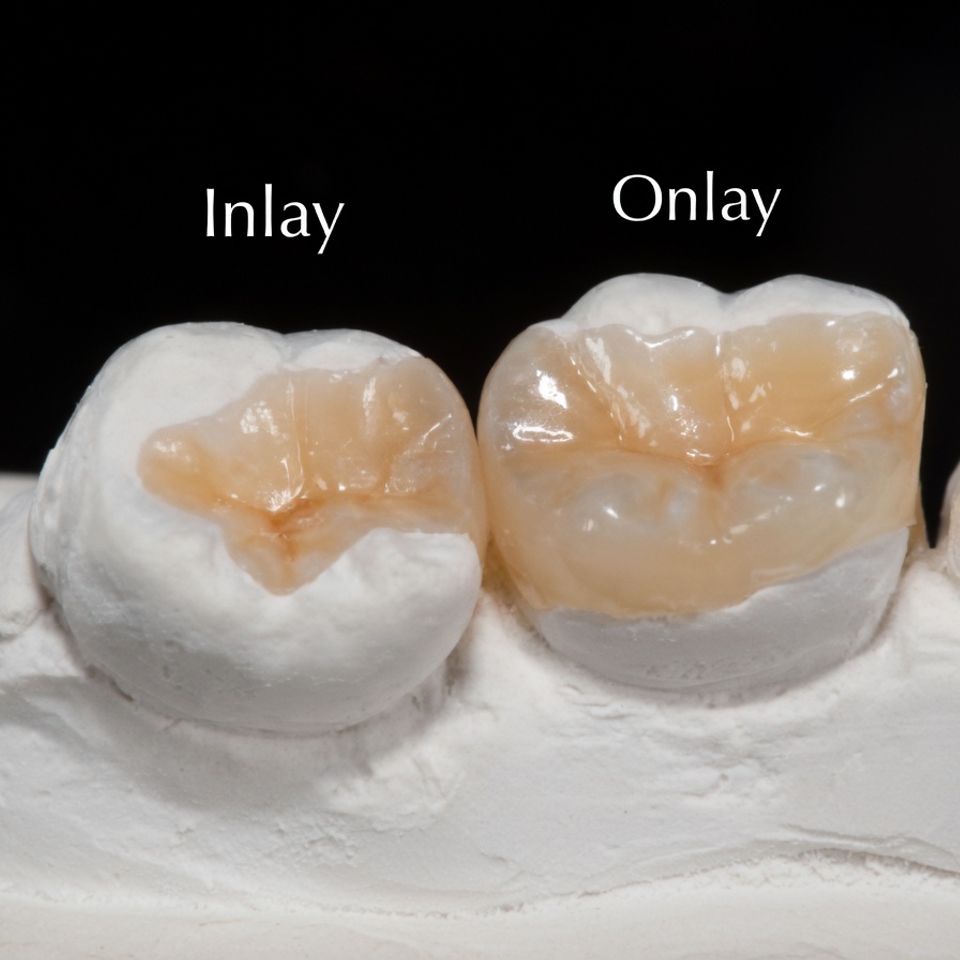
An onlay is generally used when the damaged portion of a tooth is larger than what an inlay can comfortably restore. It can cover part of the chewing surface and extend over one or more cusps of the tooth.
Onlays are particularly useful when a tooth has weakened areas that need additional protection but still has enough healthy structure to avoid complete coverage with a crown.
The decision depends on the individual tooth. A thorough examination allows your dentist to determine whether an onlay can provide sufficient support or whether another restoration would be more appropriate.
Onlays for Weakened Cusps
The cusps are the raised portions of a tooth that help you chew food. When one of these areas becomes weakened, cracked, or damaged, additional protection may be necessary.
An onlay can cover the affected cusp and restore the chewing surface while preserving suitable healthy tooth structure around it. This can be especially useful for back teeth that experience significant chewing pressure every day.
Onlays for Larger Areas of Tooth Damage
A tooth with extensive decay, a large existing filling, or structural damage may require more coverage than a traditional filling or inlay can provide.
An onlay can restore a larger portion of the tooth while avoiding complete coverage when the remaining structure is strong enough. Your dentist will assess the tooth carefully before deciding whether this conservative approach is appropriate.
Inlays and Onlays vs. Dental Fillings
Dental fillings are often appropriate for smaller areas of decay or damage. They can be placed directly into the prepared tooth and are a common way to restore teeth affected by cavities.
However, when a larger portion of the tooth has been damaged, a filling may not provide the level of support required. In these situations, an inlay or onlay may offer a more customized restoration.
The main goal is to choose a treatment that matches the amount of damage. A small cavity does not necessarily need an extensive restoration, while a significantly weakened tooth may require more protection.
Inlays and Onlays vs. Dental Crowns
A dental crown covers the entire visible portion of a prepared tooth, while an inlay or onlay restores only the damaged area. This difference makes conservative restorations useful for certain teeth that still have substantial healthy structure.
If the tooth is severely weakened, fractured, or extensively damaged, a crown may provide the additional coverage needed to protect it. If the damage is more limited, an inlay or onlay may be considered instead.
There is no universal answer for every damaged tooth. Your dentist will examine the remaining structure and recommend the restoration that provides an appropriate balance of protection, function, and preservation.
The Inlay and Onlay Treatment Process
Your treatment begins with an examination of the affected tooth. We look at the damaged area, surrounding teeth, gums, and bite to understand the complete condition of your smile. Dental imaging may be used when additional information is needed.
Once the tooth has been evaluated, we discuss your treatment options and explain why an inlay or onlay may be appropriate. The damaged or decayed portion of the tooth is then carefully removed, leaving healthy structure whenever possible.
The prepared area is used to create a restoration designed specifically for your tooth. Before placement, the restoration is checked for fit, appearance, and bite. Once everything is properly evaluated, the inlay or onlay is securely placed.
This careful process helps ensure that the restoration functions comfortably with your surrounding teeth rather than simply filling the damaged space.
Natural-Looking Inlays and Onlays in Taunton, MA
Restorative treatment should not mean sacrificing the appearance of your smile. Inlays and onlays can be designed to blend with the surrounding tooth structure and create a natural-looking result.
The shape, size, position, and appearance of the restoration are considered during treatment planning. The goal is to make the restored tooth look appropriate within your smile while also allowing it to function normally.
At Elite Dental Group, we consider both the health of the tooth and the appearance of your overall smile when planning restorative care.
Inlays and Onlays for Damaged Back Teeth
Back teeth experience considerable pressure during everyday chewing. Over time, decay, large fillings, cracks, or wear can weaken these teeth and make them more vulnerable to additional damage.
If a back tooth needs more support than a filling can provide but does not require a full crown, an inlay or onlay may be considered. The restoration can strengthen the affected area while preserving suitable natural tooth structure.
An examination is important because symptoms such as sensitivity or pain when chewing can have several different causes. Your dentist needs to determine whether the problem is decay, a damaged filling, a crack, or another condition.